
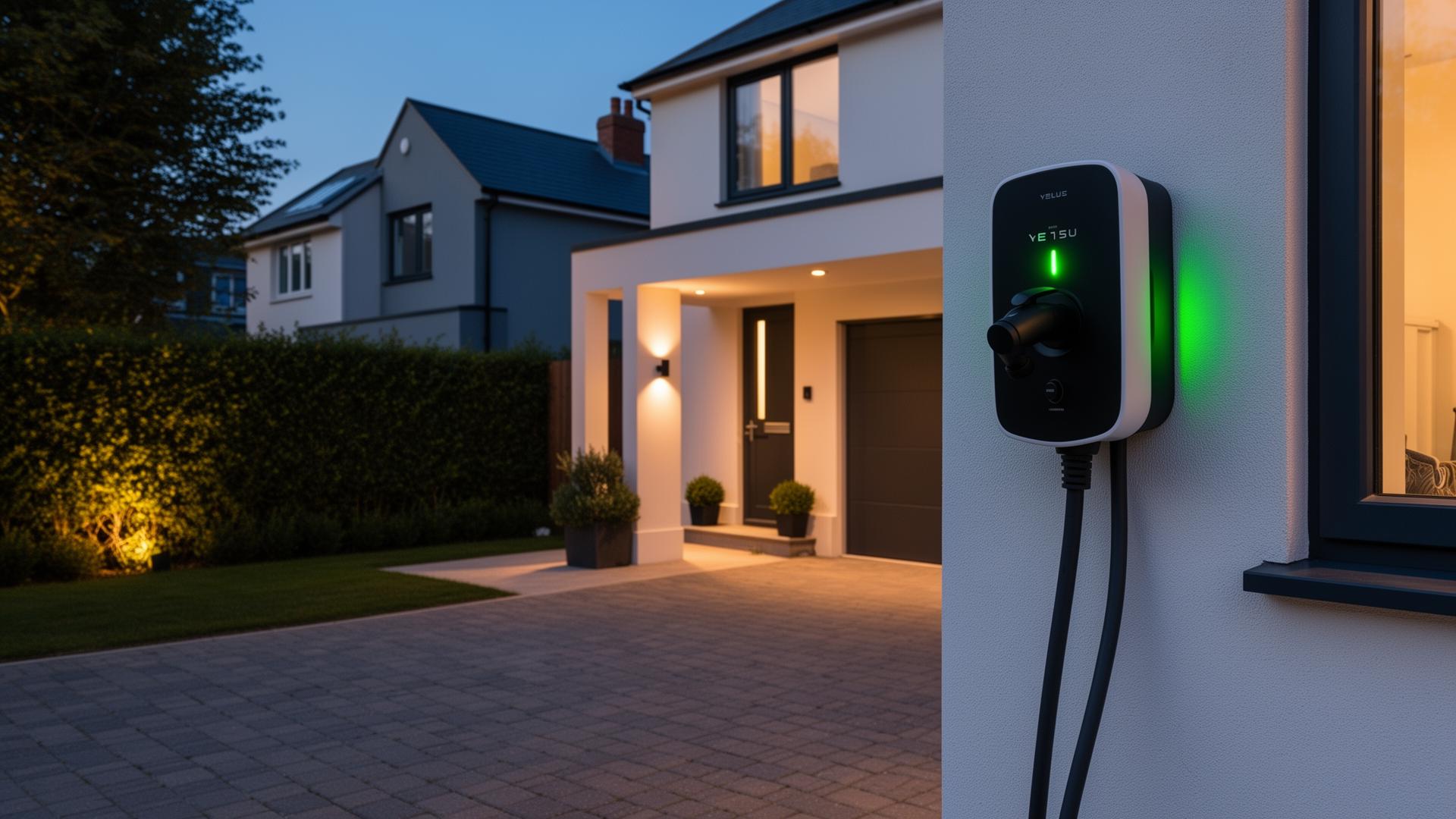
EV Charger Installation
in Crawley
Charge at Home, Save Every Day
Stop paying public charging prices. A professionally installed home charger costs a fraction per mile compared to petrol — and you wake up to a full battery every morning without leaving your driveway.
Installations for all major EV makes including Tesla, BMW, Hyundai, MG, and Volkswagen
12+ Years
Experience
Part P Registered
Registration
All EV Makes
Compatibility
Fully Insured
Coverage
Half Day
Typical Install
Why Install a Home EV Charger?
A dedicated home EV charger (also called an EVSE or wallbox) provides faster, safer, and cheaper charging than a standard 3-pin plug. Most home chargers deliver 7.4kW of power, fully charging a typical electric car in 4–8 hours overnight — compared to 12–24 hours from a domestic socket.
Charging at home on an off-peak electricity tariff costs roughly 5–7p per mile. Compare that to 15–25p per mile at public rapid chargers, or 16–20p per mile for petrol. Over 10,000 miles per year, that saving adds up to £800–£1,500 annually.
A professionally installed charger also protects your home's wiring. Charging an EV from a 3-pin socket draws a sustained 2.3kW load for many hours — something domestic sockets and wiring are not designed for. This can cause overheating, melted sockets, and in extreme cases, fire.
Lambourn Electrical Services installs EV chargers across Crawley, Horsham, Redhill, Reigate, and the wider Surrey and Sussex area. We handle everything from the initial survey to final commissioning, including any electrical upgrades needed to support the charger safely.
What Goes Wrong Without a Proper Installation?
Using a standard 3-pin plug to charge your EV is a temporary measure at best. The sustained load — typically 10 amps continuously for 12+ hours — generates significant heat in the plug, socket, and the wiring behind the wall. Over weeks and months, this accelerates wear on connections that were designed for intermittent use.
Extension leads make the problem worse. The resistance in the lead generates additional heat, and coiled leads can create hot spots. Multiple EV fires and domestic electrical fires have been traced to charging through inadequate extension leads.
An incorrectly installed charger — even a purpose-built unit — creates risks if the supply cable, circuit protection, and earthing are not properly specified. An undersized cable can overheat. Incorrect circuit protection can fail to disconnect during a fault. Inadequate earthing can energise the metal casing of the charger.
Professional installation by a Part P registered electrician ensures that the charger is connected to a correctly rated dedicated circuit, with appropriate cable sizing, a dedicated MCB and RCD or RCBO, and proper earthing. It is not a job for a general builder or a DIY enthusiast.
Our EV Charger Installation Process
Site Survey
We visit your property, assess your consumer unit capacity, identify the best charger location, and determine the cable route. We check your incoming supply to confirm it can support a 7.4kW charger.
Charger Selection & Quote
Based on your vehicle, driving habits, and property, we recommend the most suitable charger. You receive a fixed, written quote covering the charger unit, installation, and any electrical upgrades needed.
Installation
We install the charger, run a dedicated cable from your consumer unit, fit a dedicated circuit breaker, and connect the earth bonding. Typical installation takes half a day.
Configuration & Commissioning
We configure the charger's settings, connect it to your Wi-Fi (if applicable), set up the manufacturer's app, and run a full test charge to confirm everything works correctly.
Certification & Handover
You receive an Electrical Installation Certificate and the charger's warranty documentation. We walk you through the charger's features and answer any questions about optimising your charging schedule.
Benefits of Professional EV Charger Installation
Save £800–£1,500 Per Year
Home charging on an off-peak tariff costs a fraction of public charging or petrol. The charger pays for itself within 12–18 months.
Full Charge Overnight
A 7.4kW charger fully charges most EVs in 4–8 hours. Plug in before bed, wake up to 100% — no detours to charging stations.
Safe, Dedicated Circuit
A properly rated dedicated circuit eliminates the overheating risk of 3-pin charging. Your home's wiring is protected.
Smart Charging Features
Schedule charging for off-peak hours, monitor energy usage, and set charging limits — all from your phone.
Increased Property Value
A home EV charger is an increasingly valuable feature for buyers. It signals a future-ready property.
Manufacturer Warranty
All chargers come with the manufacturer's warranty (typically 3 years). Our installation is guaranteed for 12 months.
EV Charger Technical Details
The standard home EV charger in the UK delivers 7.4kW on a single-phase supply. This requires a dedicated 32A circuit protected by a Type B MCB and 30mA RCD (or a Type A RCBO with DC fault detection, depending on the charger model). The cable is typically 6mm² Twin & Earth or 6mm² SWA (Steel Wire Armoured) for outdoor runs.
For properties with a three-phase supply, 22kW chargers are available. However, most domestic properties in the UK have single-phase supplies, and 7.4kW is the maximum practical charging rate. We assess your supply during the survey and advise accordingly.
We install chargers from leading manufacturers including Ohme, Andersen, Hypervolt, EO, and Pod Point. The choice depends on your requirements: some chargers offer dynamic load management, some integrate with solar PV systems, and some offer more advanced app features.
Dynamic load management is important in properties where the incoming supply is limited. This feature monitors your home's total power draw in real time and automatically adjusts the charging rate to prevent overloading your supply. It is essential in properties with 60A or 80A main fuses.
Cable routing depends on where your charger is located relative to your consumer unit. For short runs through internal walls, standard Twin & Earth cable is used. For longer outdoor runs, we use SWA cable — a heavy-duty cable with a steel armour layer that provides mechanical protection against damage.
If your consumer unit does not have capacity for an additional 32A circuit, we may need to upgrade it as part of the installation. This is common in older properties with small consumer units or limited spare ways. We include any necessary upgrade in your quote.
All installations comply with BS 7671, IET Code of Practice for Electric Vehicle Charging Equipment, and Building Regulations Part P. The charger must also comply with the Electric Vehicles (Smart Charge Points) Regulations 2021, which require smart charging functionality for any charger installed with government funding.
Frequently Asked Questions

Need an Electrician Today?
Get a fast, honest quote with no obligation. Available 24/7 for emergencies.